Figma valuation: AI is changing the story, but dilution still matters
Figma's customer metrics remain strong, but investors still have to weigh AI monetization, stock-based compensation, and post-IPO dilution.
Short version
Figma is still growing like a premium software company. Q1 FY2026 revenue rose 46% year over year, net dollar retention improved to 139%, large-customer counts picked up, and management raised full-year revenue and non-GAAP adjusted operating profit guidance on the May 2026 earnings call.
The business is changing too. Figma is moving from a mostly seat-based design tool to a broader product-building platform, with seats, AI credits, and new creative workflows all feeding the model. The investor question is blunt: does AI make Figma more useful to product teams, or does it make parts of the design workflow easier to replace? After recent activist pressure, that question may be answered not only by the market, but also by Figma's own board.
Quick read:
- Latest FIG close used: $16.84 on 2026-06-25.
- Fair value estimate: $25/share, with a 1-year price target of $27/share.
- DCF range: $12/share in the bear case, $25/share in the base case, and $46/share in the bull case.
- Sell-side reference points: price targets range from $22 to $38, with an average near $36 across 13 analysts.
- Main upside driver: AI-led seat expansion and credit consumption.
- Main risk: stock-based compensation and dilution, AI competition, and activist scrutiny of the Anthropic relationship.
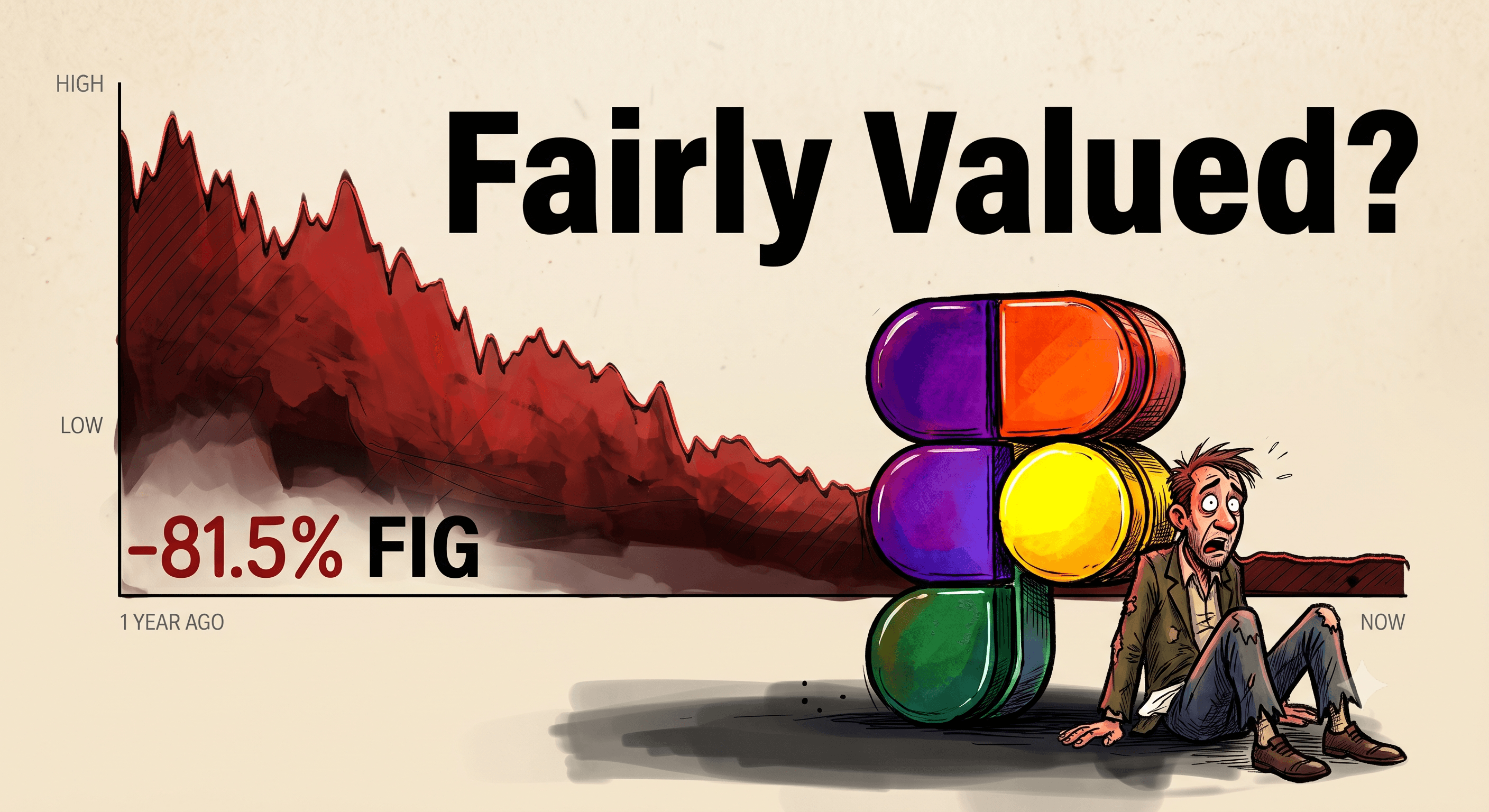
At $16.84, the stock trades below the base-case fair value estimate in this note. The operating metrics are strong, but the equity story is still weighed down by reported losses, very large stock-based compensation, and uncertainty around long-term AI margins.
Recent stock and business recap
Figma's IPO shows how far sentiment has swung. The July 31, 2025 offering priced at $33/share, opened near $85, and closed its first trading day at $115.50. That was a 250% first-day pop and put the company near a $68 billion valuation. Based on the close price on 2026-06-25, FIG was down about 85.4% from that first public close, while the S&P 500 and Nasdaq 100 were up over the same window.
| Symbol | Last close, 2026-06-25 | Return since FIG first public close, 2025-07-31 | Drawdown from period high |
|---|---|---|---|
| FIG | $16.84 | -85.4% | -86.2% |
| S&P 500 | 7,357.49 | +16.1% | -3.3% |
| Nasdaq 100 | 29,440.32 | +26.8% | -4.0% |
FIG vs market since IPO
The recent story cuts two ways.
AI-native design and coding tools may reduce the need for dedicated design software. Recent news flow included Google Stitch concerns in March and Anthropic-related competitive questions in April. The sharper development came in May 2026, when activist investor Findell Capital Management sent a public letter to Figma's CEO and board. Findell argues Figma is undervalued, but it also wants management to sharpen product focus, bring costs closer to competitors, and examine Figma's relationship with Anthropic given the overlap between Figma's roadmap and Claude-based design and coding tools. That turns part of the AI competition question into a governance question too.
The operating data points the other way. Q1 FY2026 was a beat-and-raise quarter: revenue growth accelerated, net dollar retention improved, AI credit monetization began, and Config 2026 added Code Layers, Motion, agents on the canvas, Weave workflows, and broader AI surfaces.
Sell-side views are split
Wall Street hasn't settled on a view either. Around Config 2026, analysts moved in both directions:
| Firm | Action | Rating | Price target |
|---|---|---|---|
| Citi | Initiated coverage, 2026-06-17 | Buy | $36 |
| Wells Fargo | Cut from $42, post-Config | Overweight | $36 |
| Morgan Stanley | Maintained, late June 2026 | Equal-Weight / Hold | $38 |
| RBC Capital | Cut from $28, 2026-06-25 | Sector Perform / Hold | $22 |
| JPMorgan | Maintained, late June 2026 | Neutral / Hold | Not disclosed |
| Consensus (13 analysts, third-party aggregator) | - | Buy (average) | ~$36 |
The $22-to-$38 range matters. These firms are looking at the same quarter and the same Config event, but they still disagree on whether AI is a net tailwind or net threat to Figma's core workflow. This note's $25 fair value and $27 target sit toward the lower half of that sell-side range, mainly because the dilution and margin assumptions used here are more cautious than a simple growth-multiple view would be.
The stock's decline is not, by itself, a bearish valuation argument. A lower price is attractive if the underlying business keeps executing. The useful read from the price action and the target spread is narrower: the market has low confidence in the durability of Figma's model, and the next two or three quarters should either support that doubt or push back against it.
From design tool to product-building platform
Figma's core business is collaborative software for designing and building digital products. The company is trying to expand the canvas from a place where designers work into a broader product-building surface for designers, developers, product managers, marketers, and AI agents.
On the Q1 FY2026 earnings call, management said growth came from seat expansion, retention, enterprise adoption, new users, and AI credit monetization that began on March 18, 2026. At Config 2026, management framed the strategy as an "intelligent canvas" with more materials and more AI-enabled workflows: Code Layers, Motion, shaders, 3D transforms, Weave, agents, custom skills, and MCP.
The logic is simple. AI should increase the amount of software and creative output being produced. More output creates more need for coordination, review, quality control, and design systems. Figma wants to be the shared work surface where those outputs are brought together, refined, governed, and moved toward production.
This is why Code Layers matters strategically. At Config, management said teams increasingly prototype inside individual coding agents or IDEs, but sharing and feedback become fragmented as a result. Figma's answer is to bring code-backed prototypes onto the canvas so teams can compare alternatives, comment, iterate, and move between code and design in one place.
The business model is evolving alongside the product. A year ago, Figma was largely seat-based. Today the model has more levers: full-seat upgrades, Dev Mode, AI credit add-ons, pay-as-you-go credits for Pro customers, enterprise contracting for AI usage, Governance+, advisory services, and new creative products such as Weave and Motion.
Customer expansion is the strongest part of the story
The strongest evidence is in the operating metrics. Revenue growth reaccelerated to 46% in Q1 FY2026. Net dollar retention rose to 139%, its highest level in more than two years according to management. Customers above $10k annual recurring revenue (ARR) and above $100k ARR both continued to grow.
| Period | Revenue ($m) | Revenue growth | Net dollar retention | ≥$10k ARR customers | ≥$100k ARR customers | Remaining performance obligations ($m) |
|---|---|---|---|---|---|---|
| FY2025 Q1 | 228.2 | 46.1% | 132% | 11,107 | 1,031 | 421.4 |
| FY2025 Q2 | 249.6 | 40.9% | 129% | 11,906 | 1,119 | 448.8 |
| FY2025 Q3 | 274.2 | 38.0% | 131% | 12,910 | 1,262 | 517.2 |
| FY2025 Q4 | 303.8 | 40.0% | 136% | 13,861 | 1,405 | 647.9 |
| FY2026 Q1 | 333.4 | 46.1% | 139% | 15,218 | 1,525 | 682.3 |
Revenue growth is still premium software growth
Large customers kept expanding
Enterprise expansion is visible in the numbers:
- ≥$100k ARR customers increased from 963 in FY2024 Q4 to 1,525 in FY2026 Q1, up about 58% over five quarters.
- ≥$10k ARR customers increased from 10,517 to 15,218 over the same period, up about 45%.
- On the Q1 call, management said paid customers spending more than $100k ARR grew 48% year over year, while paid customers spending more than $10k ARR grew 37%.
- Management also said over 60% of paid customers with more than $10k ARR added full seats at renewal in Q1.
- Around 60% of customers with more than $100k ARR were using Figma Make weekly in Q1, up from over 50% in Q4.
- Management cited one hyperscaler agreement with over 35,000 paid seats, a global media company that moved from organic Make usage to a company-wide rollout, a large India IT services deal, and a European industrial automation customer where engineers now outnumber designers on Figma.
Figma is not only adding smaller teams. It is expanding inside larger customers and spreading beyond designers into developers, product managers, marketers, and engineers. That matters because large-customer expansion is usually more durable than one-time AI curiosity.
AI monetization is early, but it matters
AI is currently both a growth driver and a margin question. On the Q1 call, management said AI credit limits began on March 18, 2026, and Q2 would be the first full quarter of credit monetization. The early signal was positive: more than 75% of org and enterprise users who were above their credit limits continued to use credits after enforcement, and more than 95% remained active on the platform.
Management also said Pro teams that bought AI credit add-ons had more seats per team and average annualized spend more than 3x that of teams that had not bought add-ons. That suggests credits may not only add usage revenue, but may also correlate with better seat expansion.
The offset is cost. AI inference and model training put pressure on cost of revenue, R&D, and sales and marketing. Management did not give a hard gross-margin floor. Instead, it said the focus is gross profit dollars and long-term product ubiquity, with cost levers such as model routing, model-agnostic architecture, and first-party models trained on Figma's design corpus.
For investors, this means gross margin may remain lower than historic pure-SaaS levels while AI usage scales. That is acceptable if revenue growth and retention improve enough to offset it. It is a problem if AI usage becomes expensive but hard to monetize.
Financials, book value, employees, and cash flow
The financial picture is mixed. Revenue growth and free cash flow are strong. Reported profitability is poor because stock-based compensation is very high after the IPO.
| Period | Revenue ($m) | Gross margin | Reported op. margin | FCF margin | SBC ($m) |
|---|---|---|---|---|---|
| FY2025 Q1 | 228.2 | 91.5% | 17.4% | 41.4% | 0.2 |
| FY2025 Q2 | 249.6 | 88.8% | 0.8% | 24.3% | 7.3 |
| FY2025 Q3 | 274.2 | 69.4% | -414.6% | 17.9% | 1,138.3 |
| FY2025 Q4 | 303.8 | 82.1% | -64.4% | 12.7% | 218.3 |
| FY2026 Q1 | 333.4 | 79.4% | -41.2% | 26.6% | 169.0 |
Stock-based compensation explains the gap between GAAP loss and cash flow
FCF = Free Cash Flow SBC = Stock Based Compensation
Why the reported operating loss is so large
Trailing twelve-month reported operating loss was about $1.47 billion. Trailing twelve-month stock-based compensation was about $1.53 billion. Nearly all of the reported operating loss comes from stock-based compensation rather than cash operating burn. That still costs shareholders through dilution, but it is not the same thing as the headline loss number.
The FY2025 Q3 spike to $1.14 billion of stock-based compensation is the clean example. This is a known accounting pattern for restricted stock units that vest only once both a service condition and a liquidity-event condition, such as an IPO, are met. No expense is recognized while the company is private. Once the liquidity event occurs, GAAP requires an immediate cumulative catch-up charge for the service period employees have already completed. That accounting trigger, not a sudden change in pay practice, is the main driver of the outsized FY2025 Q3 loss. The same pattern shows up at other companies that go public with double-trigger RSUs.
In the Q1 FY2026 filing, Figma reported $170.8 million of stock-based compensation in stockholders' equity, 10.2 million shares issued upon release of restricted stock units, and 3.6 million shares withheld for taxes upon equity-award release. The FY2025 annual filing also says the company drew $330.5 million on its revolver to pay tax withholding and remittance obligations associated with restricted stock unit net settlement in connection with the IPO, then used part of the IPO proceeds to repay the debt.
On an employee basis, the stock-based compensation number looks huge. The caveat matters more than the number itself: these are not normal run-rate compensation figures. They are inflated by the same post-IPO cumulative catch-up described above, plus legacy pre-IPO grants now vesting on their original schedule.
Figma had 1,886 employees at 2025 year-end, up from 1,014 at 2022 year-end.
| Date | Employees | Change vs prior data point | Growth |
|---|---|---|---|
| 2022-12-31 | 1,014 | - | - |
| 2025-12-31 | 1,886 | +872 | +86.0% |
Using 1,886 employees as the denominator:
| Metric | Amount |
|---|---|
| Q1 FY2026 stock-based compensation | $169.0m |
| Q1 FY2026 stock-based compensation per employee | about $90k for the quarter |
| Trailing twelve-month stock-based compensation | $1.53bn |
| Trailing twelve-month stock-based compensation per employee | about $813k |
These per-employee figures are useful for one narrow reason: they make concrete why dilution, not cash burn, is the central valuation issue here. Headcount growth explains part of the rise in ordinary employee-related expense, but the size and timing of the reported loss is mostly an equity-accounting story, not an operating one.
Balance sheet and book value
Figma has a strong balance sheet. Based on Q1 FY2026 data as of 2026-03-31, it had about $1.66 billion of cash and investments, $56 million of debt, and net cash of about $1.61 billion.
| Period | Cash/investments ($m) | Net cash ($m) | Deferred revenue ($m) | Book value ($m) | BV/share |
|---|---|---|---|---|---|
| FY2025 Q1 | 1,551.6 | 1,484.8 | 406.6 | 1,370.4 | $6.38 |
| FY2025 Q2 | 1,633.3 | 1,568.6 | 433.1 | 1,427.2 | $6.64 |
| FY2025 Q3 | 1,617.7 | 1,556.4 | 473.6 | 1,388.5 | $3.44 |
| FY2025 Q4 | 1,681.3 | 1,622.8 | 595.3 | 1,510.6 | $4.48 |
| FY2026 Q1 | 1,664.0 | 1,607.8 | 627.7 | 1,457.0 | $2.78 |
Net cash stayed strong while book value per share fell
Deferred revenue rose from $406.6 million in FY2025 Q1 to $627.7 million in FY2026 Q1. That supports the revenue growth story and shows continued advance billing. Book value per share fell despite positive net cash because share count expanded materially after the IPO and equity-award releases.
Cash flow quality
Q1 FY2026 free cash flow was $88.6 million, or 26.6% of revenue. Trailing twelve-month free cash flow was $236.7 million, a 20.4% margin. Management noted on the Q1 call that a new annual corporate bonus program created a $56 million Q1 cash outflow and reduced Q1 free-cash-flow margin by 17 percentage points.
The product has strong cash-flow potential, but equity compensation is absorbing a large part of the economic value right now. Figma's long-term valuation depends on whether revenue growth, operating leverage, and lower stock-based compensation as a percentage of revenue can reduce dilution over the next several years.
Competition
"AI competition" is too broad unless it is broken down by workflow. Figma is not facing one clean substitute. It is facing pressure on several jobs that used to sit inside or around the design file.
| Workflow at risk | Specific competitors / tools | What they may replace | Why Figma may still matter |
|---|---|---|---|
| Prompt-to-UI mockups | Google Stitch, Claude design-style workflows, Vercel v0, Lovable, Bolt.new, Replit Agent | Early wireframes, landing pages, quick prototypes, simple app screens | Teams still need design systems, feedback, versioning, brand rules, and production handoff |
| Design-to-code handoff | Cursor, Windsurf, GitHub Copilot, coding agents in IDEs | Parts of Dev Mode, specs, developer handoff, front-end implementation steps | Figma's MCP and Code Layers try to connect generated code back to the source design context |
| Visual asset generation | Adobe Firefly, Canva AI, Midjourney-style workflows | Marketing images, social assets, rough creative concepts | Figma is strongest when assets must connect to product systems and collaborative review |
| Whiteboarding and planning | Miro, FigJam alternatives, Notion-style workspaces | Brainstorming, journey maps, planning artifacts | Figma can connect ideation to design, prototype, code, and customer-facing assets |
| Website/product publishing | Webflow, Framer, Canva sites, AI website builders | Simple sites, microsites, landing pages | Figma can win when the work starts in product design and needs shared systems |
The specific replacement risk is strongest in low-complexity work: first drafts, simple prototypes, one-off landing pages, and basic UI screens. Those use cases can be generated outside Figma. The risk is weaker in complex product work where teams care about shared design systems, multi-person review, enterprise governance, accessibility, security, and the final path to production.
The best competitive argument for Figma is not "AI cannot design." AI can already create useful drafts. The stronger argument is that enterprise product work is rarely one prompt and done. It requires iteration, comparison, approvals, brand and design-system constraints, and handoff across designers, PMs, engineers, legal, and marketing. Figma is trying to own that shared layer.
Management's strongest competitive argument is context. On the Q1 FY2026 earnings call, Dylan Field highlighted three differentiators: a performant multiplayer canvas, deep product context, and the ability to combine AI, design, code, and direct manipulation in one place. At Config, management expanded that point: the more work that happens on Figma, the more context Figma has, and the more useful its agents and workflows can become.
That is plausible, but not guaranteed. The company has to keep shipping quickly because AI-native tools are improving fast and some will be good enough for lightweight design work. The Anthropic relationship is no longer just a row in this competitive table. After Findell Capital's letter, it is also a board-level governance question.
Valuation and discounted cash flow model
Based on the last close price of $16.84 as of 2026-06-25 and 528.38 million shares, the implied market capitalization is about $8.9 billion. After $1.61 billion of net cash, enterprise value is about $7.3 billion. Against FY2026 revenue guidance midpoint of $1.425 billion, that is roughly 5.1x forward revenue. Against trailing twelve-month free cash flow of $236.7 million, enterprise value / free cash flow is roughly 31x.
A useful cross-check is to compare Figma with other software companies that went public in recent years. The table below uses a 2026-06-25 close for Figma and the latest Yahoo fundamental time-series data available at that time.
| Company | Category | Price return since first public close | Latest revenue growth | Enterprise value / trailing twelve-month sales | Trailing twelve-month free cash flow margin |
|---|---|---|---|---|---|
| Figma | Design/product platform | -85.4% | 46.1% | 6.3x | 20.4% |
| Snowflake | Data cloud | -10.6% | 33.5% | 17.1x | 23.2% |
| Datadog | Observability | +488.4% | 32.2% | 22.3x | 26.1% |
| GitLab | DevOps | -73.5% | 23.1% | 3.6x | 26.2% |
| Klaviyo | Marketing automation | -57.2% | 27.9% | 2.7x | 15.4% |
| Rubrik | Cyber/data security | +91.9% | 39.0% | 10.0x | 19.5% |
| monday.com | Work management | -62.5% | 24.5% | 2.1x | 23.4% |
This comparison makes Figma look neither obviously cheap nor obviously expensive. It is much cheaper than Datadog and Snowflake on enterprise value / sales despite faster reported growth, but those companies have longer public operating records and less uncertainty around the design-AI threat. Figma is more expensive than GitLab, Klaviyo, and monday.com, but it is also growing faster than those companies in the latest quarter. Rubrik is a useful midpoint: similar free cash flow margin, slightly lower growth, and a higher enterprise value / sales multiple.
Figma's current multiple only makes sense if the market is applying a large discount for AI substitution risk, dilution, and now governance uncertainty. If Q2 and Q3 show that AI credits are incremental and that large customers keep expanding, the stock can reasonably trade above the current ~6x trailing twelve-month sales level. If AI competition starts to slow net dollar retention or gross margin falls without matching revenue upside, the lower peer multiples become more relevant.
The discounted cash flow uses normalized free cash flow. This is more useful than reported net income right now because reported losses are dominated by post-IPO stock-based compensation. However, dilution is modeled explicitly, so stock-based compensation is not ignored.
Discounted cash flow scenarios cluster around the base case
Main scenario assumptions
| Scenario | Year 1 revenue growth | Year 10 revenue growth | Year 1 free cash flow margin | Terminal free cash flow margin | Discount rate | Terminal growth |
|---|---|---|---|---|---|---|
| Bear | 24% | 3% | 12% | 25% | 11.5% | 2.5% |
| Base | 30% | 4% | 17% | 30% | 10.5% | 3.0% |
| Bull | 35% | 5% | 20% | 33% | 9.5% | 3.5% |
The base case starts with FY2026 revenue guidance midpoint of $1.425 billion. It assumes growth fades gradually as the business scales, while free cash flow margin expands as the company gets operating leverage and AI monetization offsets inference costs. It also assumes dilution of 3% per year for five years, then 1% per year for five years. That is roughly in line with the pace of RSU-driven share growth seen in Figma's first year as a public company, though actual future dilution will depend on management decisions, including any buybacks the company has not yet detailed.
Scenario output
| Scenario | Terminal revenue ($m) | Terminal free cash flow margin | Fair value/share | Upside/downside vs $16.84 |
|---|---|---|---|---|
| Bear | 4,118 | 25% | $12.48 | -25.9% |
| Base | 5,771 | 30% | $24.52 | +45.6% |
| Bull | 7,931 | 33% | $45.69 | +171.3% |
The base case gives a current fair value of about $25/share, roughly 46% above the $16.84 close used in this update. The 1-year target is $27/share, slightly above current fair value, because Figma should either prove or disprove the early AI monetization thesis over the next few quarters. If the Q2 and Q3 data confirm that credits are driving incremental revenue without severe margin pressure, the market should be willing to underwrite a higher multiple.
What the Monte Carlo simulation means
The Monte Carlo simulation is a stress test, not a separate forecast. Instead of using one fixed set of assumptions, it tests 10,000 random discounted cash flow cases around reasonable ranges for revenue growth, free cash flow margin, discount rate, terminal growth, FY2026 revenue base, and dilution.
The simulation produced this distribution:
| Metric | Value |
|---|---|
| Number of runs | 10,000 |
| Mean fair value | $26.00 |
| 10th percentile | $20.70 |
| 25th percentile | $22.85 |
| Median | $25.57 |
| 75th percentile | $28.71 |
| 90th percentile | $31.84 |
In most of the reasonable random cases, the valuation clusters in the low-to-high $20s. The 10th percentile means only 10% of simulated outcomes were below $20.70; the 90th percentile means only 10% were above $31.84. At the current $16.84 price, even the 10th-percentile simulated outcome sits above the market price. Put differently, most simulated scenarios, including fairly cautious ones, land above where the stock trades today. That reflects this model's assumptions, not a guarantee about the future, but it supports treating $25 as a base case rather than a stretch case. {{ chart:monte-carlo }}
Bull case
The bullish case is that Figma becomes more important as AI creates more software and more design work. If code generation becomes cheaper, product quality, taste, design systems, governance, and collaborative review become more valuable. Figma already owns a lot of that workflow context.
What supports the bull case:
- Revenue growth reaccelerated to 46% in Q1 FY2026.
- Net dollar retention improved to 139%, the highest level in more than two years.
- Enterprise expansion is supported by faster growth in ≥$100k ARR customers, higher Make usage among large customers, and full-seat additions at renewal.
- AI credits introduce a second monetization layer on top of seats.
- Remaining performance obligations increased to $682.3 million, improving near-term revenue visibility.
- The balance sheet has about $1.6 billion of net cash.
- The stock price already reflects a lot of competitive concern, and Citi's June 2026 Buy initiation plus a low-to-mid-$30s average sell-side target suggest at least part of Wall Street sees room for a re-rating rather than continued de-rating.
Bear case
The bearish case is that Figma is a high-growth company with a fragile multiple. AI may expand usage, but it also raises inference costs, increases competition, and may weaken seat-based pricing over time. Reported losses are large, and stock-based compensation makes cash flow look cleaner than owner economics.
What supports the bear case:
- The stock's decline matters mainly as a sentiment and momentum signal, not as a standalone valuation argument.
- Findell Capital Management's May 2026 letter adds a governance dimension on top of the product-competition risk: it specifically asks the board to examine Figma's relationship with Anthropic, whose Claude-based tools compete with parts of Figma's roadmap. That is a different kind of risk than a slow quarter because it can affect strategic direction independent of near-term financial results.
- Sell-side estimates are unusually dispersed (RBC at $22 versus Citi at $36, both as of late June 2026), signaling real disagreement about the durability of the model rather than a settled view investors can lean on.
- Gross margin has moved lower as AI usage and product mix changed.
- Trailing twelve-month reported operating loss was about $1.47 billion, mainly because trailing twelve-month stock-based compensation was about $1.53 billion.
- Diluted shares increased materially after the IPO, and book value per share fell to $2.78 by Q1 FY2026.
- If AI design tools become good enough for many users, Figma may need to spend more and price more carefully.
- Multi-class voting control limits outside shareholder influence, which also limits how much an activist campaign like Findell's can force change even if its concerns are valid.
Bottom line
Figma is not a simple value stock. It is a high-growth software platform with strong customer metrics, a large net cash position, and an improving AI monetization story. It also has heavy stock-based compensation, dilution, reported losses, fast-changing competition, and, as of May 2026, an activist shareholder pushing the board to address its relationship with one of its more visible AI competitors.
Current fair value estimate: $25/share. 1-year price target: $27/share. At the $16.84 close used in this update, that implies roughly 48% upside to the current fair value estimate. The stock looks undervalued if Figma keeps revenue growth above 30%, sustains high net dollar retention, and turns AI credits into profitable incremental revenue. The main reasons to be cautious are dilution, the possibility that AI competition compresses long-term margins or reduces pricing power, and the added uncertainty from activist and governance pressure that did not exist in earlier quarters.
Primary public inputs: company filings, Q1 FY2026 earnings call dated 2026-05-14, Config 2026 investor session dated 2026-06-24, Findell Capital Management's May 2026 public letter to Figma's board, sell-side analyst notes published around Config 2026 (Citi, Wells Fargo, Morgan Stanley, RBC Capital, JPMorgan), Figma's July 2025 IPO pricing and first-day trading data, company profile data, employee history, news headlines, and daily closing prices.
This report is for informational purposes only and does not constitute investment advice, a recommendation, or an offer to buy or sell any security. Forward-looking figures (fair value estimates, price targets, DCF and Monte Carlo outputs) are based on stated assumptions that may not occur. Data points are sourced from public filings and third-party reporting as of the dates indicated throughout this report and may be stale by the time this is read